
SHAOXU LI |李韶旭
在这三幅绘画中,我选取了最基本的元素——植物与动物、人类,以及抽象的自然——来探讨人类与异化自然世界之间的关系。画中所描绘的动植物,其尺度明显大于人类,被界定为承载未知与威胁交织感受的象征性存在。因此,我将这些象征性的形体嵌入环绕人物的、混沌而失序的自然背景之中。
那些看似无序的色彩,是通过刮刀反复施加颜料后留下的痕迹,意在以主观方式表达人体意识中自我失落的感受,以及不断流动的焦虑。通过形式上的实验,我发现,以刮刀将彼此无关的色彩交错铺陈而不加混合,似乎能够隐喻一种持续流变与不确定的状态。这些独特的痕迹,或许代表了一种只有在颜料与画布相互作用中才能实现的视觉语言。
In these three paintings, I have selected fundamental elements—plants and animals, humans, and abstract nature—to explore the relationship between humanity and an alienated natural world.The flora and fauna depicted, whose proportions markedly exceed those of humans, are defined as symbolic entities embodying an intertwined sense of the unknown and menace. Thus, I embed these symbolic forms within a chaotic backdrop of nature surrounding the human figure. The seemingly disordered colours are traces left by applying paint with a palette knife, intended to subjectively express the sense of self-loss and fluid anxiety within human consciousness.Through formal experimentation, I discovered that interweaving unrelated colours with a palette knife without blending them seems to metaphorically convey a state of perpetual flux and uncertainty. These distinctive traces may represent a distinct visual language achievable only through the interaction of pigment and canvas.
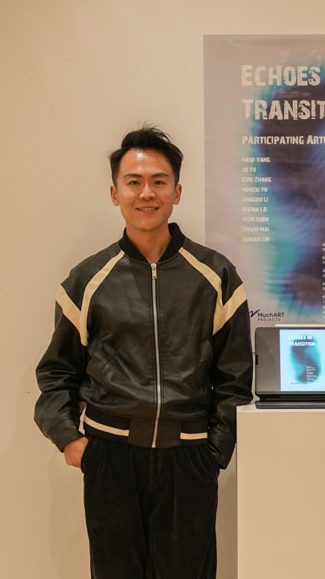
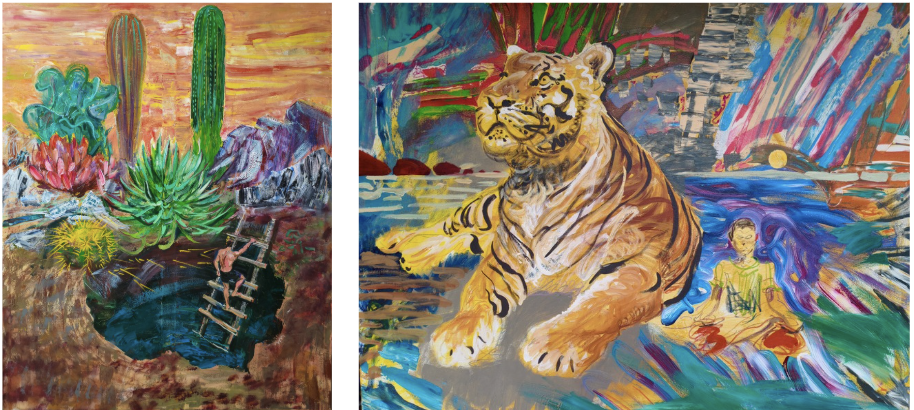
Ci 刺,2025
布面丙烯油画, 150 × 120 cm
Courtesy of the Artist
李韶旭的绘画以“人-自然”的心理关系为核心。他笔下的动植物被放大到不安的尺度,像是与世界脱节的象征,既熟悉又陌生。画面由刮刀反复涂抹的色彩构成,看似无序,却带有强烈的精神流动感。
这些画不是描绘自然,而是描绘“意识如何被动摇”。当环境失序、秩序松动,人类作为万物中心的想象就被解除,取而代之的是焦虑、威胁、未知与自我失控。
在《过渡回响》中,他的作品呈现出一种与现实同步的裂痕:变化没有来势汹汹,但在不断侵蚀。
Li Shaoxu’s painting centers on the psychological relationship between humans and nature. The animals and plants in his work are enlarged to an unsettling scale, appearing as symbols of disconnection from the world—at once familiar and strange. His surfaces are built through repeated applications of color with a palette knife; seemingly unordered, they nevertheless carry a strong sense of psychic movement. These paintings do not depict nature itself, but rather the way consciousness is shaken. When environments fall out of order and systems begin to loosen, the fantasy of humanity as the center of all things is undone, replaced by anxiety, threat, uncertainty, and a loss of self-control. In Echoes in Transition, his works reveal a fissure that runs parallel to reality: change does not arrive violently, but erodes continuously.