
JIE FU |付洁
付洁是一位跨学科艺术家、设计师及人机交互(HCI)研究者,专注于XR沉浸式体验与AI驱动的视觉生成。她现为伦敦艺术大学创意计算研究所博士候选人,其研究聚焦于数据与人工智能驱动的空间创作系统。
她开发的沉浸式平台 Dream Space XR 曾入围UKRI Innovate UK Immersive Tech Awards与European XR Awards。其AI生成时尚影像 Fashioning the East 荣获四项MUSE Design Awards,并被China Art Museum永久收藏。
她的研究成果发表于 Frontiers in Computer Science、ACM Creativity & Cognition 以及 Journal of Cleaner Production。其作品曾在London Transport Museum、China Art Museum、Chicago 及伦敦Minster Building展出。
此外,她创立了DREAMCREATIVE,并与星巴克、爱马仕、Ports及Estée Lauder Companies等品牌展开合作。
Jie Fu is an interdisciplinary artist, designer, and HCI researcher specializing in XR immersive experiences and AI-driven visual generation. Currently a PhD candidate at the Creative Computing Institute, University of the Arts London, her research focuses on data and AI-driven spatial authoring systems.
Her immersive platform Dream Space XR was a finalist for both the UKRI Innovate UK Immersive Tech Awards and the European XR Awards. Her AI-generated fashion film Fashioning the East received four MUSE Design Awards and entered the permanent collection of the China Art Museum.
Her research has been published in Frontiers in Computer Science, ACM Creativity & Cognition, and the Journal of Cleaner Production. Fu’s works have been exhibited at the London Transport Museum, China Art Museum, Chicago, and London’s Minster Building. She founded DREAMCREATIVE, collaborating with brands such as Starbucks, Hermès, Ports, and Estée Lauder Companies.
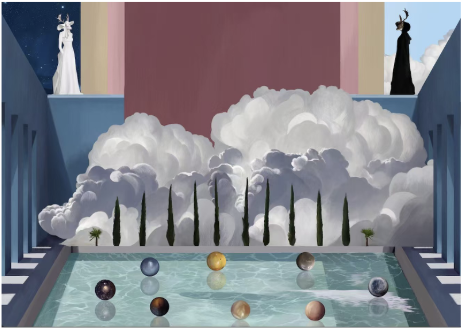
Days and Moons 日与月,2025
Printed on canvas 布面绘画, 84 × 59cm
Courtesy of the Artist
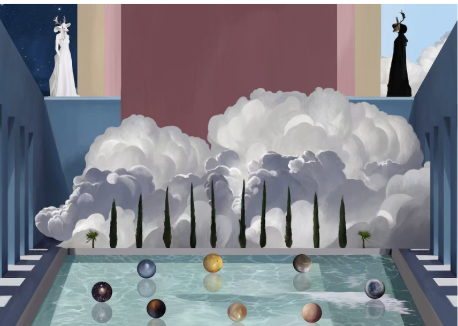
Days and Moons 日与月,
2025
Printed on canvas 布面绘画,
84 × 59cm
Courtesy of the Artist
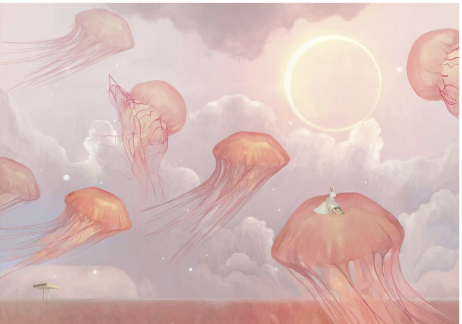
Transparent Heart,
2025
Printed on canvas 布面绘画,
84 × 59cm
Courtesy of the Artist
付洁的作品《昼与月》以“自我的双重性”为核心。在“从一日到另一日,从一个自我到另一个自我”的流转中,她捕捉了昼夜交替那一瞬的永恒。
画面被分割为两个互为镜像的世界:左侧,白角的女神立于深蓝的幽暗中;右侧,黑色的剪影沐浴在金色的光辉里。两者之间,一池静水托起漂浮的球体,它们如星体般巡游——有的灿烂如烈阳,有的深邃如黑洞,有的斑驳如大地。这一空间成为了时间的剧场:对称却不重复,明暗交织,去留无声。一排柏树如沉默的见证者,标记着这场永无止境的邂逅。
这组画作不是在描绘自然节律,而是在描绘“生命如何通过遇见而完整”。这种灵感源自对存在主义诗意的体悟:我们在行进中与风雨星辰相遇,在停歇时与聚散欢欣相遇。而那个最终遇见的“你”,或许是他人,或许是另一个时空的自我。两位守护者既是独立的灵魂,又是同一生命体的镜像状态。
《昼与月》呈现出一种关于“门槛”的哲学:我们始终在跨越边界,与风景、与他人、与不同版本的自我碰撞。黑与白并非对立,而是彼此依存的底色——没有黑夜的深度,白昼便无从闪耀;没有“你”的存在,自我便始终残缺。那些漂浮的球体象征着生命中的无数瞬间:有的如初见般明亮,有的如告别般黯淡。它们像行星一样靠近又分离,在意识的引力中留下波纹——那是生成、消融、并再度重逢的痕迹。
Jie Fu’s work Day and Moon centres on the notion of a divided self. Within the passage “from one day to the next, from one self to another,” she captures the fleeting yet enduring threshold of transition between day and night.
The composition is structured as two mirrored yet distinct realms. On the left, a white-horned figure stands within a deep, nocturnal blue; on the right, a dark silhouette is immersed in a field of golden light. Between them, a still body of water supports a constellation of floating spheres, which drift like celestial bodies—some radiant as suns, others dense as black holes, others mottled like the surface of the earth. This space unfolds as a theatre of time: symmetrical yet non-repetitive, where light and shadow interweave, and arrival and departure remain unspoken. A row of cypress trees stands as silent witnesses, marking an encounter that is continuous and unresolved.
Rather than depicting natural cycles, the work reflects on how life attains a sense of completeness through encounters. Its sensibility draws on a poetic understanding of existence: in movement, one encounters wind, weather, and the cosmos; in stillness, one encounters convergence and dispersal, joy and loss. The “other” encountered may be another person, or a self situated in a different temporal or spatial register. The two figures function both as autonomous presences and as mirrored states of a single being.
Day and Moon articulates a philosophy of the threshold. It suggests that existence is constituted through continual crossings—between environments, between others, and between multiple versions of the self. Black and white are not oppositional, but mutually constitutive: without the depth of night, daylight cannot emerge; without the presence of the other, the self remains incomplete. The floating spheres evoke the multiplicity of lived moments—some luminous as first encounters, others dimmed like farewells. Like planets, they approach and recede, leaving subtle traces within the gravitational field of consciousness: marks of formation, dissolution, and return.